Our mission
To develop and validate artificial intelligence that measurably improves access to accurate diagnosis and timely care in low-resource health settings — built with, and owned by, the communities it serves.
We are a research lab at Makerere University developing artificial intelligence for diagnosis, disease surveillance and health systems strengthening — and the datasets, governance and partnerships that make that work credible.
To develop and validate artificial intelligence that measurably improves access to accurate diagnosis and timely care in low-resource health settings — built with, and owned by, the communities it serves.
Health systems across Africa supported by AI that is locally developed, clinically validated, ethically governed, and trusted by the health workers who rely on it.
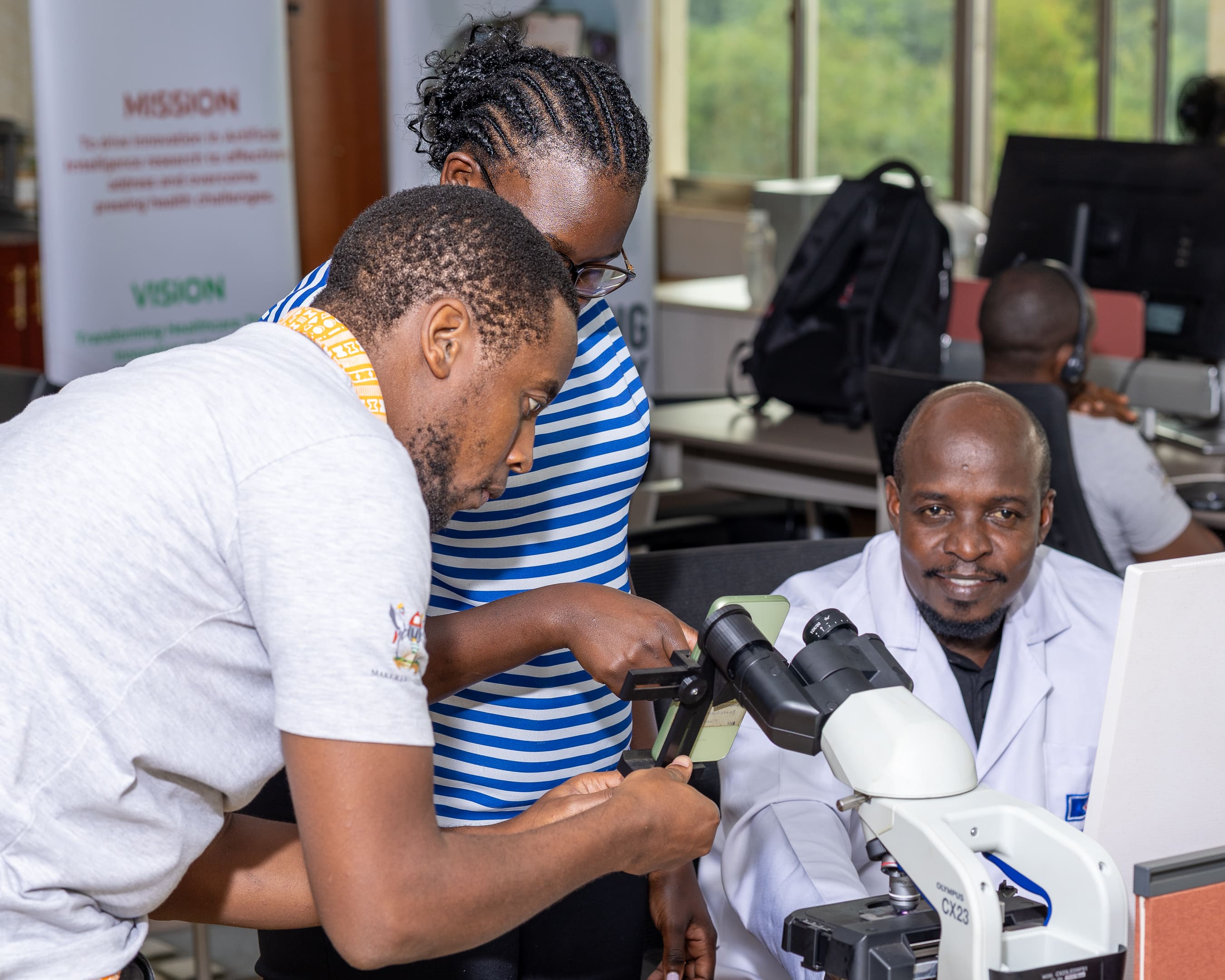
We build diagnostic tools. Low-cost hardware such as 3D-printed smartphone-to-microscope adapters, paired with deep learning models that help identify pathogens in blood smears and other samples.
We curate datasets. High-quality labelled medical imaging data from African clinical settings, openly licensed so that other researchers can build on it rather than starting from scratch.
We validate in real settings. Tools are tested in the health facilities and laboratories where they are meant to be used, with the staff who will use them.
We build capacity and partnerships. Training students and early-career researchers, and convening the wider community through networks and conferences.
The case for this work is not that AI is new. It is that the constraints African health systems operate under are specific, and general-purpose tools built elsewhere do not address them.
Expert microscopists, radiologists and pathologists are concentrated in a small number of referral facilities. Decision support extends that expertise to where patients actually present.
A diagnosis that requires travelling to a regional hospital is a diagnosis many patients never receive. Point-of-care tools shorten that path.
Models trained on data from elsewhere encode assumptions about equipment, sample preparation and disease prevalence that do not hold here.
Intermittent power and connectivity are design constraints, not edge cases. Tools have to work offline and on the devices staff already carry.
Where African health data is collected, it should be governed and owned locally, with clear terms for how it is used.
Diagnostic data collected at the point of care can support disease surveillance and public health response, not just the individual patient.
Each stage feeds the next, and each has its own governance and validation requirements.
Working with hospitals, laboratories and health centres to collect clinical samples and images under approved protocols and informed consent.
Expert annotation by laboratory technicians and clinicians, with quality control and clear licensing terms.
Building and evaluating models against the labelled data, with attention to performance across sites and sample conditions.
Testing in the settings where the tool will be used, with the health workers who will use it.
Packaging as mobile and web tools that work within existing workflows and infrastructure constraints.
Tracking real-world performance and feeding findings back into the next cycle.
These are the commitments that shape how we design studies, handle data and deploy tools. They describe our own practice; they are not claims of regulatory approval or clinical certification.
Clinical images and records are de-identified before they leave the facility, and access to identifiable data is restricted to the study team under approved protocols.
Every dataset has documented provenance, consent basis, licensing terms and an accountable custodian. Openly released datasets state clearly what may and may not be done with them.
We evaluate performance across collection sites, equipment and sample conditions rather than reporting a single aggregate figure, because those are the axes along which performance realistically varies.
Our tools are designed as decision support. A trained health worker interprets the output and makes the clinical decision; the system does not diagnose autonomously.
Performance is assessed against expert reference standards in the settings where a tool is intended to be used, before it is put into routine use.
Data collected in African health facilities stays under African institutional custodianship, with local researchers as principal investigators and co-authors, not just data collectors.
We deploy incrementally, with monitoring in place and a route to withdraw or revise a tool if real-world performance does not hold.
Health workers and the institutions hosting the work are involved in design and review, not consulted only at the point of rollout.





Research partnerships, dataset access, clinical validation sites, funding and student opportunities.